
The Conscious and Unconscious Brain
“Our Three brains” – The idea about our three brains in the book “Designing with the Mind in Mind”(J Johnson- 2014), sits on top of Don Norman’s idea of the Three levels of Processing in the Human brain, which I wrote about a couple of weeks ago, or was that a simplified version of this one? Let’s get into the nitty-gritty of this!
This concept was first introduced by Paul MacLean in the 1960s and is widely exclaimed as The Concept of Triune Brain. In the book, Jeff Johnson looks at it in the light of User experience Design.
The Three Brains in simple vocabulary: The Old Brain, Mid Brain, and New Brain. The old Brain is responsible for primal actions and instincts like identifying threats, the Midbrain generate emotions, perceptions, and remain largely unconscious. The New brain is where all your conscious planning and activity takes place. Scientists have further divided these as System 1 and System 2.
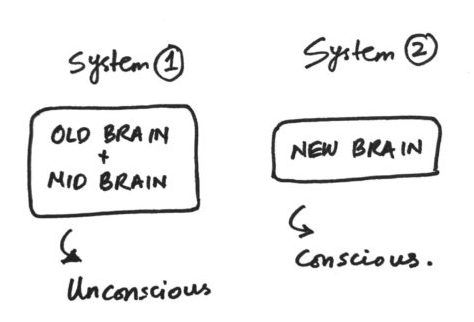
System 1, which is Old Brain and Mid Brain working together, performs all regular everyday tasks that do not need conscious planning. it’s fast and runs on intuitions, guesswork, and is easily biased, we now understand where ‘First Impressions’ fall in. Learned behavior or actions are also regulated by System 1 like driving your everyday route to work. System 1 is also called the Unconscious brain. System 2 – the New brain, on the other hand, is responsible for conscious planning activities and rational thoughts. It’s the system that’s working right now when I am writing, the system that works when we do calculations or try to find a new address.
It’s all logical, I had no idea, but I get it. Here’s the twist to this story: System 1 is the where our majority of work is done, I was surprised to hear that but here it goes. System 1 runs in the background and requires no effort from, it’s constantly making decisions and completing tasks or just thinking. System 2, on the other hand, is lazy and only gets up when it’s needed, it argues amiably with system 1 on making decisions. System 1 wins most of the time
How do we use this knowledge to our advantage in designing? – Design for System 2 unless necessary. Johnson argues that people get on a website or app with a goal, it is unfair for us to create friction and roadblocks in their way. Instead, make getting to their goal so easy that they don’t need to use their conscious brain. To achieve this kind of Design, we need to create the correct Calls to Action (CTA) that has clear information scent, keep the Conceptual Model of the user in mind and not make things over complicated, use thought out navigation that guides the user to their goal, use search bars, display status in a form, use calendars to choose dates, so on and so forth.
Let’s put things into perspective – just for fun. Imagine you need to pay your electricity bill. You put on the website and see that your computer already has the logins saved (no need to use your conscious brain to figure out the password or take a tangent to find it written somewhere, great!). Once logged in, you see the action button ‘Pay Bill’ right in front, you click that (didn’t have to use system 2 to find in Navigation, perfect). Since you are logged in, your account number and total amount due are visible, moreover, your credit card information is saved (if we ignore the many data breaches, we can agree it’s so easy to have your information saved – no need for system 2, again). You click the submit button and you are done. This was practically a smooth unconscious activity. Now think about your water bill website that has Pay Bill in 3rd tier Navigation, System 2 is activated!
A great breakdown! Thanks for taking me on a tour of your System 2 brain!